
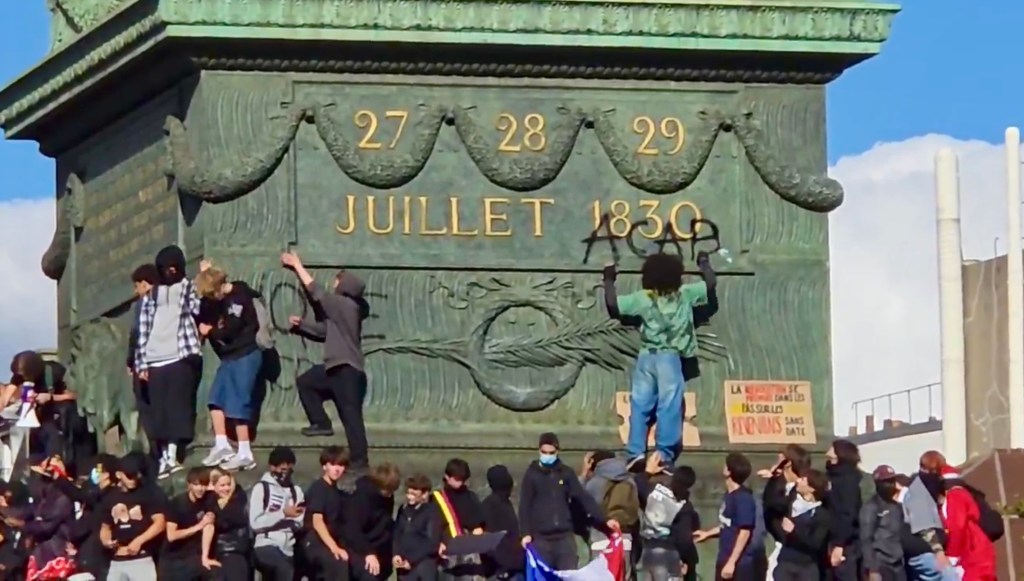
Credit: @AnthoDepe (Twitter)
It’s been an October to remember, and we’re not even halfway through it. Everywhere I look there are people taking to the streets. From France to Spain and India down to Brazil and Chile – even the DSA’s golden child Mamdani got whacked with protests, first at an October 7 vigil he attended then again the next day after an ICE agent shot someone in the Bronx. Closer to home, school bus drivers here in Puerto Rico shut down one of the busiest highways in San Juan protesting high diesel prices. The air has been boiling for months, and it looks like collectively we’ve reached a breaking point. Each of these protests have their individual inciting event but, like everything else we are experiencing, it’s all connected. There is a shared discontent and disappointment across the planet with young people, as usual, being the vanguard demanding change. People are yearning for the ability to live in dignity. Whether it’s affordable rent in Spain, adequately funded education in France and Chile, voting rights in India, or the preservation of democracy in Brazil, the root cause of these confrontations stem from an elite class determined to funnel as much wealth as possible upwards.
France
Unless you haven’t had internet access for the past two weeks you may have heard about the protests across France. It’s remarkable. The conviction of these young people and their defiance in the face of incredible police violence injects a kind of fervor and inspiration into me that I haven’t felt since the Ricky Renuncia protests here in PR back in 2019. French high school students have been experiencing inequality within their education system with underfunding disproportionately affecting students in the suburbs where lower-income families live. The unbearable conditions include dilapidated facilities with no climate control and rat infestations, class sizes of over 35 students per teacher, school days running from 8am to 6pm (wtf), and inadequate teacher staffing leading to gaps in student schedules throughout those ridiculously long days. It has been three straight weeks of protests from Paris to Marseille – naturally the police response has been barbaric. The use of exploding stun grenades led to a 15 year old boy losing his hand, another child lost his eye, and there was footage posted online showing police officers drowning a protester. According to the Ministry of Justice, nearly 7,000 people have been arrested during the protests (most of them being minors) and there are estimates over 160,000 students and trade unionists participated in the demonstrations so far.
What strikes me the most about the French protests is the solidarity between the more affluent students in Paris who don’t face the difficulties mentioned earlier and the lower-income students of the suburbs who are most affected. It’s Paris where the police are seeing some of the most ardent physical pushback from protestors. It is the white Parisian students that news outlets have been giving their microphones to and to their credit they have consistently shifted the focus back to the inequality imposed on their suburban (largely Black and brown) peers. There are also a number of notable schools who have unexpectedly joined the blockades such as Université Assas, widely regard as conservative and right-leaning, and École du Louvre which has never participated in a blockade in its 144 year history. Numerous trade unions representing education, transportation, and postal workers have also helped organize and participate in the actions. Interspersed in the marches you’ll inevitably see keffiyehs and Palestinian flags – symbols representing the pursuit of freedom adopted by people all over the world. The students recognize the intersectionality of oppression that spans from France to Palestine. These are unprecedented times in a country defined by its revolutionary spirit. This coming Saturday is slated to be the largest protest to date across the country and I don’t expect the kids to stop there.
Video: @TwIttNTIN (Twitter)
Spain
In Spain, the eviction of an 87 year old woman named Maricarmen Abascal sparked outrage and protests across the country. Maricarmen was fighting a real estate developer called Urbagesa who bought the building that she’d been living in for over seven decades. Urbagesa demanded Maricarmen accept a 230% increase in her rent (from €500 to €1,650 a month) or be evicted. Her fight became a symbol of Spain’s housing affordability crisis. Supporters camped outside her home blocking police from getting inside. According to a General Council of the Judiciary Report there is an average of 44 evictions in Spain per day. The cause can be traced back to developers like Urbagesa as well as the rise of Airbnb converting long-term housing into high-priced short term holiday rentals. In central Madrid, there are roughly 40 short-term rentals for every 100 apartments.
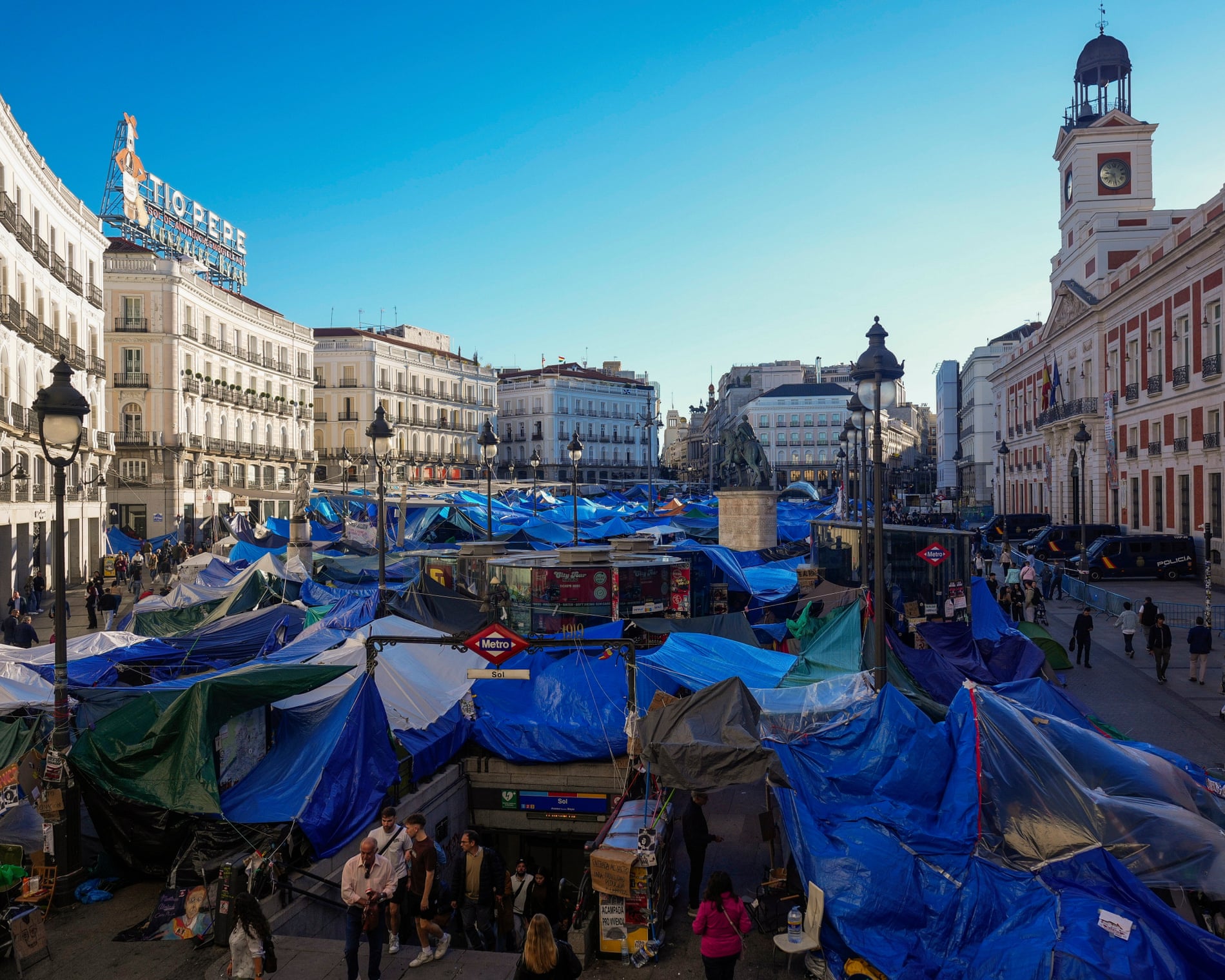
After an eight year long battle and three previous eviction attempts, Urbagesa finally succeeded in removing Maricarmen with the help of Madrid’s riot police on September 23rd. She died two weeks later. How many years did that fight and ultimate loss take from her? About 20,000 protestors took to the streets last Thursday after her death to hold a vigil. Housing affordability has taken center stage in the upcoming snap elections called by prime minister Pedro Sánchez at the end of November. Calls for a general strike have also grown louder since Maricarmen’s death and protestors are still encamped in Puerta del Sol. Maricarmen’s story is tragic in every possible way but it hits me especially hard because displacement and gentrification has followed my family back in NY and here in Puerto Rico. I see the infestation of Airbnbs in San Juan and over tourism across the island pricing people out of housing every single day.
Photograph: Borja Sanchez-Trillo/EPA
India
Over in India the Cockroach Janta Party (CJP), formed earlier this year by frustrated students, who have been in the streets facing police violence for months are demanding the chief election commissioner Gyanesh Kumar to resign after more than 130 million names were deleted from voter lists. Unsurprisingly, this purge favors the current Hindu nationalist Baharatiya Janata Party (BJP) of Prime Minister Narendra Modi who has been in power for over a decade. The Cockroach movement satirically adopted its name after the country’s highest ranking judge derisively compared unemployed students to cockroaches during a hearing. Over the weekend CJP leaders along with nearly 1,000 other protesters were arrested in Delhi after police shut the city down in an effort to block a march. The simmering discontent from a lack of equal access to higher education and employment after graduation accompanying Modi’s years in leadership has boiled over. The frustration is justified with youth unemployment sitting at 15% according to a recent survey and unemployment among graduates at nearly 40%.
Earlier in the summer protesters successfully pressured the education minister to resign. That win spurred even more energy behind the CJP movement despite unrelenting police suppression. The state’s behavior in Delhi this past weekend convinced protesters that the country is in a state of emergency – which in India means the government is allowed to rescind civil liberties such as protesting. It’s hard to disagree when the government has engaged in a pattern of denying protest permits, forcing them to be held in different locations, and “de-notifying” (banning demonstrations) in particular spaces. After their release on Sunday, leaders of the movement held a press conference where they defiantly rebuked the use of force by police and declared that “[t]he state is at war with its own citizens.” Undeterred, CJP leaders held another demonstration this morning in Jantar Mantar Delhi – a location that was de-notified yesterday. They were arrested again.
There is an entire generation of young people across the planet who rightfully feel their futures are being stolen from them. The advent of social media and mass internet access have given kids everywhere an unvarnished view of just how fucked the planet is. The overt contempt for children and young people from the most powerful individuals in the world is reflected through government policy and directly influences their day-to-day lives. The funding cuts to education, lack of affordable housing, repression of voting rights, ongoing genocide, and the active destruction to our shared environment has not stopped them from fighting. Defiance indicates hope. These kids who are outside confronting the police can see a better future is possible. If the youngest among us who have to live on this planet the longest can still hope, Millennials and Gen X have no excuse to turn to despair and nihilism. Historically, Octobers have been fertile ground for the seeds of revolution. How can I not be hopeful this wave of protests are the start of the inevitable?

